𝔦𝔫𝔱𝔯𝔢𝔭𝔦𝔡 𝔯𝔞𝔳𝔢 𝔯𝔢𝔭𝔬𝔯𝔱: ℜ𝔦𝔠𝔞𝔯𝔡𝔬 𝔙𝔦𝔩𝔩𝔞𝔩𝔬𝔟𝔬𝔰 𝔞𝔱 𝔒𝔭𝔢𝔫 𝔊𝔯𝔬𝔲𝔫𝔡
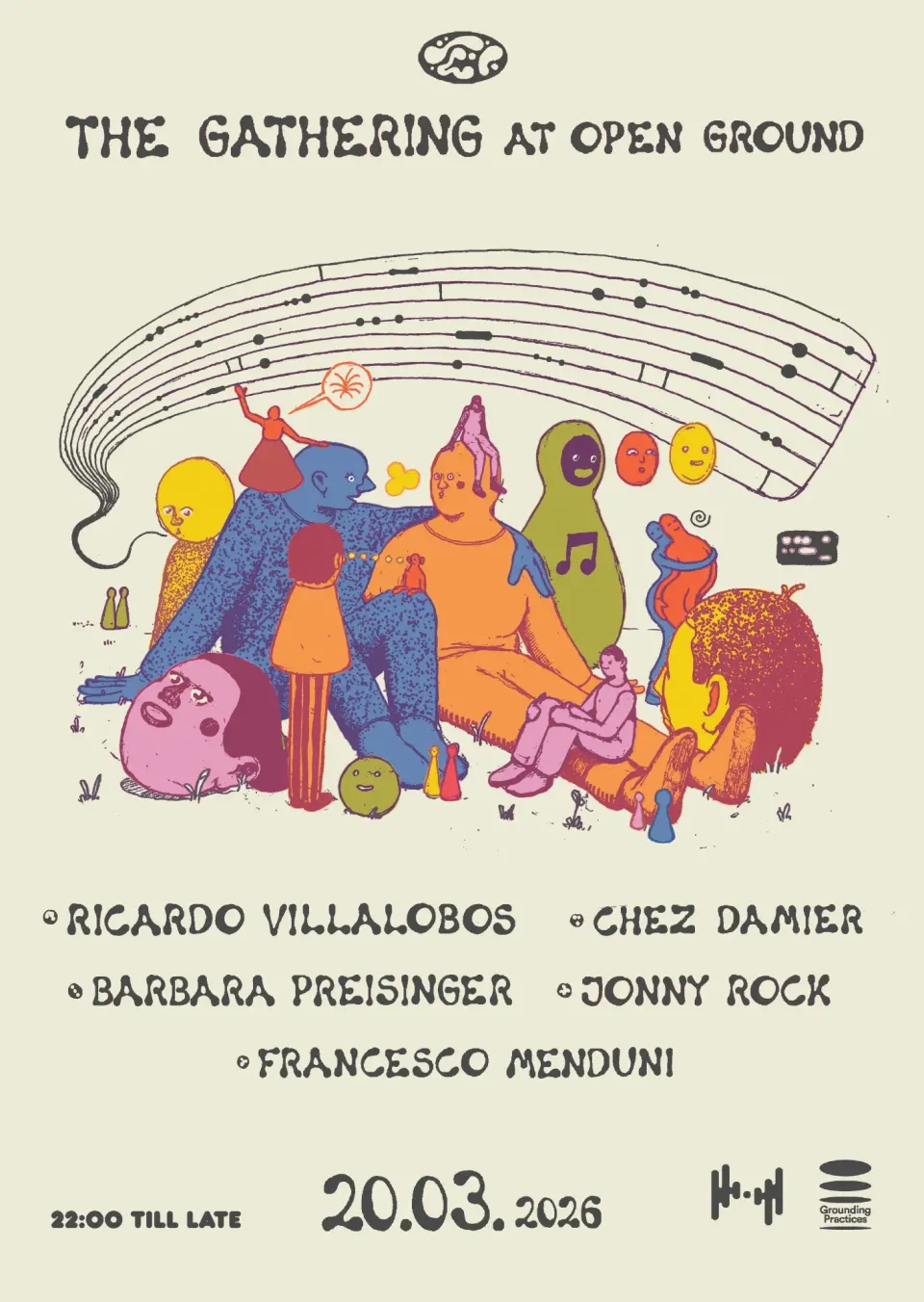
I didn't realize until I made it to coat check that the party at Open Ground a couple Fridays ago was called The Gathering, a title I learned from the T-shirts they'd made just for the occasion. I can't say why exactly — maybe I was just at a low ebb after a train journey that was not without its hiccups, maybe I just struggle to hear that phrase without thinking of juggalos — but this struck me as a little corny. Sure, it was a big night: the first appearance by Ricardo Villalobos, a famously sound-obsessed DJ, at Open Ground, one of the few clubs in the world whose system would meet his famously lofty standard. For me and many others, the idea of hearing Ricardo in that room was titillating enough to justify an hours-long journey to Wuppertal (I spoke to people who came from Berlin, Amsterdam, Paris and Greece). The party was long since sold out and had people scrambling for tickets, myself included. Still though. Custom merch? "The Gathering?"
My shitty attitude didn't last long. I'd gotten there early, planning to get a stamp then pop back to my hotel to rest up for a bit. But by the time I got inside the main room was full and Barbara Preisinger was bringing the minimal / deep house rave in a way I hadn't heard in years — basically, a perfect delivery of the style that first got me into dance music, and that, for me and countless others, has been the only musical constant throughout my adult life, attracting new fans and artists even as its pioneers push 60.
The sense of community was palpable. Amidst the punters on the dance floor were DJs, promoters and other industry folks from around Germany and Europe, there not for business but for pleasure. I was alone, but quickly found old friends to hang out with. Throughout the night, I traded unspoken, Fight Club-style nods of recognition with strangers, simply because we'd crossed paths at so many parties over the years. One of them tipped his glass to me. Another stopped me in a hallway to give me a wordless fist-bump. It was a family affair for the DJs, too. Chez Damier's link to Ernestus goes back to the '90s, and he's been in Ricardo's orbit a lot lately — he played before him the last time I saw either of them, at New Kids On Acid in 2023, and delivers one of the best tracks on Where There Is No Sun, a new compilation of Sun Ra remixes compiled by Ricardo. Watching Barbara from the front row, it was clear the night was special for her, too. She looked absolutely giddy as she dished out one gem after another (Lil Tony's "Treehouse" was the only one I recognized). Maybe "The Gathering" wasn't such an exaggeration after all. I ditched my plan to go back to the hotel. (I bought the T-shirt, too.)
As has by now been thoroughly established, Open Ground, founded by Mark Ernestus of Basic Channel / Rhythm & Sound and fellow Hard Wax alum Markus Riedel, is a nightclub aimed at perfection of the form. Every last detail is lovingly considered, from the way the music is piped into the sitting area and chill-out cubbies through clear but quiet speakers, to the raised platform at the back of the main room that lets you take a break with a clear view of the action, to, of course, the soundsystem, a painstaking feat of acoustics and underground excavation that achieves the main room's namesake: "Frei Feld," or free-field, the acoustic concept of a space in which no sound reflection occurs (the club's name could also read as a loose translation of this term). Open Ground has rightfully earned a reputation as being possibly the best-sounding club in the world (numerous DJs say it brought them to tears). A few years since it opened, DJs and punters turn up knowing to expect something different — namely, a place that prioritizes the presentation of music above all else. Other clubs may have a more memorable atmosphere or transcendent level of hedonism. But Open Ground is the best place to go for any artist you really want to hear properly.
All of which made Ricardo's first gig there a momentous occasion. Catching Ricardo at his best, in a setting where he'll deliver the surreal magic that makes him a mythologized figure, can make you feel like, say, a rare bird photographer. You need to apply considerable effort and pragmatism to being at the right place at the right time. He is a notoriously unpredictable performer. On any given night, he could be transcendently good, drearily average, explosively party-rocking, bafflingly experimental, or, a little too often, might simply not turn up.
The way Ricardo is worshipped by his fans complicates things further. At the peak of his hype it was impossible to see him in Berlin without the room being uncomfortably packed and full of people so determined to stake out a spot with a good view of him they seemed to forget to have fun. Inevitably for an artist with such broad appeal, there are always people who seem to be there not because they know or like his music but because of a more generalized allure — in other words, hype. This bothers Ricardo more than maybe anyone else. "People have to love you because they had certain experiences with you, or they had specific conversations with you, or something like that," he says in the documentary Feiern : Don't Forget To Go Home. "Not because they heard they have to love you. That's horrible." (This phenomenon would only get more intense since 2006, the year that film came out.)
This was less of a problem than usual at Open Ground, but it still made for some awkward moments. In the last 15 minutes of Chez Damier's set, the first few rows on the dance floor were suddenly impenetrable. As always, there was an enormous cheer when Ricardo appeared in the booth. Usually he tries to make a discreet entrance, even sitting on the floor by the decks before he plays. This time he was flamboyantly visible, sitting on the table in the booth and swinging his legs as he got ready to play.
I had to admit it was a cool scene: Ricardo in silhouette theatrically flipping through his opening run of records, Mark Ernestus on one side whispering in his ear, Chez Damier on the other throwing his hand in the air as the crowd cheered for his final track. But as much as the crowd lapped up Chez's set of storming Chicago house, there was something cringey about how ecstatic they were to see him pass the headphones to Ricardo. I couldn't help but wince when an especially explosive cheer went up for a drop that happened just seconds after the switch. Presumably, people thought this was Ricardo's first track, but it was clearly still Chez's last one. So in other words... the same record got a much bigger reaction when people thought Ricardo had played it. Maybe it's business as usual for them but I couldn't help but wonder what those two thought about that.
Ricardo's actual first tune announced itself pretty clearly: a skeletal minimal number with a hypnotically intricate rim pattern and an expertly deployed opening kick drum, clean and heavy, popping out as if in 3-D. (This one got a different kind of cheer — more of a low-key "whoooooooh".) From there he moved slowly through the moody and poetic end of his own discography. Early on we got "Que Belle Epoque," played from beginning to end, and "Hireklon," which, to my surprise, I recognized just from the modular synth blobs floating through the intro. This was one of many moments when the subtle sound design of his records came through in a way I'd never experienced. Contrasts between electronic textures and samples of live instruments were especially striking. In that long section of "Hireklon" when it's just the guitar with no drums, the physicality of the instrument came through with stunning clarity. Weird as it sounds, it reminded me of the first time I saw Sunn O))), a concert that felt like a meditation on the physics of an electric guitar being played through an amp, and on sound itself.
Sometime near the end of "Hireklon," Ricardo started throwing the faders around, which might have seemed like a sure sign he was about to get the party started. First he was whacking in some bleepy minimal thing that indeed would have taken things in a more conventionally clubby direction. He never ended up playing that one. Instead, we got his meandering remix of Thomas Dolby's "One Of Our Submarines," a strange and haunting track that lingered in my memory more than anything else that night.
By the time we found ourselves drifting through "Kime Ne," it was clear moody poetics would be the prevailing theme of the night. There were a few tech house belters, but they were few and far between, and the first arrived at least an hour in — a moment that led someone in the crowd to scream "na endlich!" (finally!), as good an example as any of the distance between where Ricardo's heart lies and what much of his audience wants from him. (I couldn't help but think of The Simpsons episode when Homer yells at a rock band get to the chorus already.)
Far as this was from the full-tilt party mode Ricardo sometimes delivers (at Houghton, for instance, or the last time I saw him at Watergate), there was no shortage of fireworks. "Spritzcussion" and "Enfants" both rocked. One section had easily the flashiest mixing I've seen from him. From what I could tell, he had some kind of stomping Baltimore club track on one CDJ, but kept the set moving forward on the other two, circling back to that Baltimore club track again and again, each time grabbing shorter and shorter loops of it, so the vocal hook shrank and shrank until it was just a fraction of a word. Then, when you thought for sure he was done with that one, the vocal fragment started flicking back in — played backwards.
Still, the main attraction of the night was very much the sonically experimental side of Ricardo's musical universe. At least half the music was from his own catalog — you got the sense he wanted to hear what his own records sounded like in that room. I don't blame him. Tracks I'd known for twenty years made more sense to me there than ever before. At home, his modular synth explorations can sound a little flat. At Open Ground, they had a warmth and immersive depth of field I'd never properly experienced. In "The Contempt," for instance, the strumming guitar sounded wide and up-close, while the walkie-talkie vocal hovered off to the side of the stereo field and the kick drum thumped away in the middle distance. The surprise hit of the night was "Ferenc," an unassuming track from Dependent and Happy with a ghostly melody and field recording of a city street that was psychedelically vivid in this setting.
Sometime around 9:15 AM, Ricardo played a long, dusty dub track and disappeared, permanently and without fanfare. "Huh," I said to my companion. "I guess that's it." We agreed it was the best time we'd seen him in years and ambled out of the club happily exhausted.
I wasn't surprised to see the night get mixed reviews on Reddit. Some people found it "hard to follow" and "at odds with the crowd," which I wouldn't really disagree with. Someone asked for an ID of a track that, in their words, sounded like a "spindly minimal tune with a muffled lullaby underneath." That was Ricardo's most recent 12-inch, a remix of "Kanskje" by the Norwegian band Building Instrument, which was indeed one of the loveliest moments of the night, a memory I returned to over and over in the week that followed. This was exactly what I'd gone to find in Wuppertal: a sonically rich and uncompromising performance, crafted not for the festivals and club nights he plays every weekend but for a room full of friends and dedicated fans. A gathering, if you will.
You can listen to all the tracks mentioned here in this playlist.
Member discussion